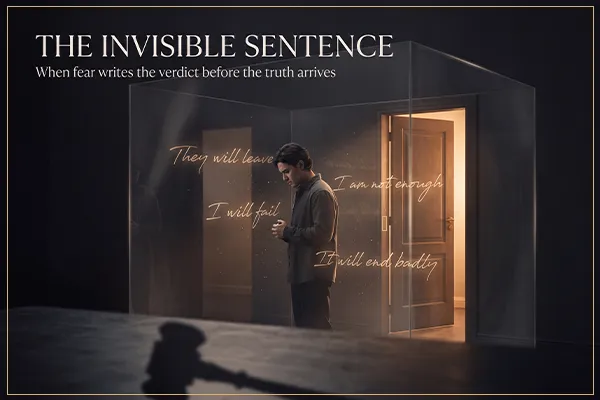
Assumptions and Your Invisible Sentence
The Invisible Sentence
Some people sentence themselves before anyone else has spoken.
They do not wait for the conversation.
They do not wait for the question.
They do not wait for the truth.
They do not wait to see whether the other person will understand.
Their mind has already created the outcome.
Rejection.
Conflict.
Disappointment.
Abandonment.
Failure.
Humiliation.
Loss.
They stand before an imagined courtroom, hear an imagined verdict, and begin serving a sentence no one else issued.
That is the invisible sentence.
It is not always obvious from the outside.
From the outside, it may look like avoidance.
They will not answer directly.
They delay the conversation.
They keep things vague.
They disappear into work.
They act as if everything is fine.
They wait until the pressure passes.
But underneath the avoidance, their mind may be running through every possible consequence.
If I say this, they will be hurt.
If I tell the truth, they will leave.
If I admit what I want, someone will be disappointed.
If I explain myself, I will fail.
If I open the door, I will not survive what comes through it.
So they close the door before anyone knocks.
This is how assumptions become a life strategy.
The person mistakes prediction for protection.
They believe they are preventing pain by avoiding the conversation.
But often, they are only creating a different kind of pain — one that grows in silence, confusion, and distance.
Some people do not avoid the conversation because they know how it will end.
They avoid it because they already punished themselves with an ending they invented.
That sentence becomes powerful because it feels real inside the body.
Anxiety does not always feel like imagination.
It can feel like fact.
It can feel like warning.
It can feel like wisdom.
It can feel like certainty.
The mind says, “Do not say it.”
The body says, “Danger.”
The heart says, “But I need to.”
The fear says, “You already know what will happen.”
And fear often wins.
But fear is not always telling the truth.
Sometimes fear is repeating an old story in a new room.
A person may be responding to a past rejection, a past failure, a past conflict, a past humiliation, a past abandonment, or a past version of themselves that did not know how to survive being exposed.
The present conversation becomes contaminated by an old wound.
The person across from them may not be the threat.
But the body remembers threat.
So the person reacts to what they expect instead of what is actually happening.
This creates a painful distortion in relationships.
One person is asking for clarity.
The other hears accusation.
One person is asking for honesty.
The other hears rejection.
One person is asking to understand.
The other hears danger.
One person is trying to get closer.
The other prepares to escape.
That is how two people can be in the same conversation and experience completely different realities.
The assumption becomes a wall.
And the person making the assumption may not realize they are forcing the other person to live with the consequences of a verdict they never gave.
This is where trust starts to erode.
Because when someone keeps responding to an imagined ending, the real relationship never gets a chance to speak.
The conversation that might have brought relief never happens.
The truth that might have created understanding never lands.
The repair that might have restored safety never begins.
Instead, the person retreats into the sentence.
They assume the worst.
They avoid the risk.
They protect themselves from a pain that may not have happened.
And in doing so, they create the pain they feared.
This is the paradox of avoidance.
Trying to prevent conflict often creates rupture.
Trying to prevent disappointment often creates distrust.
Trying to prevent rejection often creates distance.
Trying to control the outcome often destroys the possibility of connection.
The invisible sentence feels protective because it gives the person an answer before uncertainty can touch them.
But certainty built on fear is not wisdom.
It is confinement.
At some point, a person has to challenge the sentence.
Not every difficult conversation is a threat.
Not every disappointed person is leaving.
Not every question is an attack.
Not every need is a demand.
Not every truth will destroy the life.
Some conversations are painful because they matter.
Some truths are hard because they are necessary.
Some vulnerability feels dangerous because it is asking a person to leave the prison of prediction and enter the risk of reality.
That is where freedom begins.
Not when the outcome is guaranteed.
But when a person stops obeying the sentence fear wrote for them.
