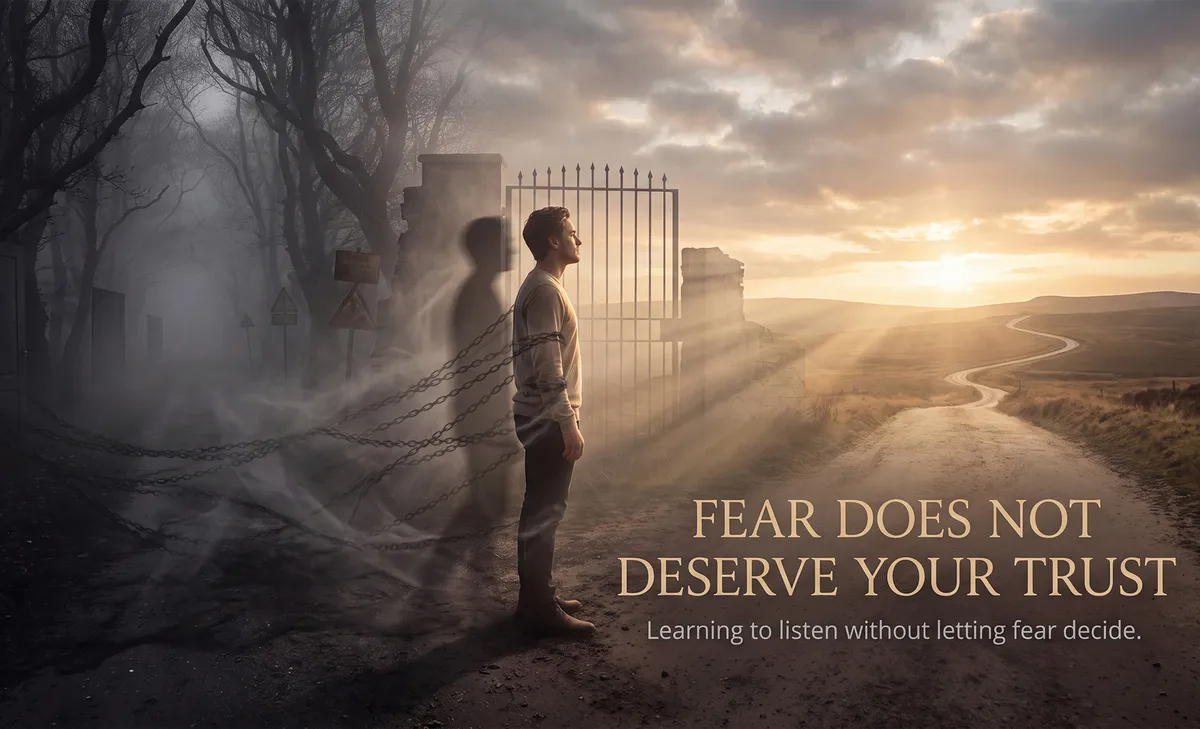
Fear Does Not Deserve Your Trust
Fear may try to protect you, but it is not always telling you the truth.
That is hard to accept because fear can sound so convincing.
Fear does not always arrive screaming.
Sometimes it arrives dressed as logic.
It says, “This is not the right time.”
It says, “Do not disrupt what is stable.”
It says, “You already know how this will end.”
It says, “You are being responsible.”
It says, “Silence is safer.”
It says, “Avoiding this is peace.”
Fear knows how to sound mature.
It can dress itself as duty.
It can dress itself as loyalty.
It can dress itself as patience.
It can dress itself as protection.
It can dress itself as being practical.
But not every practical-sounding thought is wise.
Sometimes it is fear trying to keep control.
Fear’s primary goal is not fulfillment.
It is survival.
It is designed to scan for threat, minimize exposure, reduce risk, and keep the person away from pain.
That can be useful when danger is real.
But fear often struggles to distinguish discomfort from danger.
A hard conversation can feel dangerous.
A vulnerable confession can feel dangerous.
A necessary choice can feel dangerous.
A truth that may disappoint someone can feel dangerous.
A life change can feel dangerous even when staying is what is slowly destroying someone.
This is why fear does not deserve blind trust.
Fear may give information.
But it should not always get authority.
A person can listen to fear without obeying it.
They can ask:
“What are you trying to protect?”
They can ask:
“Is this danger or discomfort?”
They can ask:
“Is this wisdom or an old wound?”
They can ask:
“What will this cost me if I keep letting fear decide?”
That last question matters.
Because fear can keep a person safe from discomfort and still cost them the life they wanted.
Fear can protect the image while destroying intimacy.
Fear can protect stability while killing truth.
Fear can protect someone from rejection while also preventing them from being fully loved.
Fear can protect them from a hard conversation while creating years of distance.
Fear can protect them from disappointing others while teaching them to abandon themselves.
This is the trade no one wants to name.
Every time fear makes the decision, something else pays the price.
Honesty pays.
Peace pays.
Love pays.
Clarity pays.
The body pays.
The future pays.
The person waiting on the other side of the silence pays.
Fear often asks for immediate relief.
Do not say it.
Do not choose.
Do not risk.
Do not explain.
Do not open the door.
And relief comes.
For a moment, the pressure drops.
The conversation is avoided.
The discomfort is delayed.
The person can return to the familiar rhythm of life.
But relief is not resolution.
The unresolved thing waits.
It waits in the body.
It waits in the relationship.
It waits in the silence.
It waits in the growing distance between what is true and what is being lived.
This is how fear becomes expensive.
At first, it feels like protection.
Then it becomes a pattern.
Then it becomes a life.
A person may look calm from the outside while fear is making nearly every meaningful decision underneath the surface.
Fear decides what they say.
Fear decides what they avoid.
Fear decides who they disappoint.
Fear decides what truth stays hidden.
Fear decides how much love is allowed to enter.
And because fear is so good at sounding reasonable, they may not realize how much authority they have given it.
They may call it timing.
They may call it responsibility.
They may call it keeping peace.
But peace that requires self-betrayal is not peace.
It is containment.
There is a difference between moving carefully and living fearfully.
Moving carefully considers consequences.
Living fearfully lets consequences become a cage.
Moving carefully honors responsibilities.
Living fearfully uses responsibility to avoid truth.
Moving carefully protects people from unnecessary harm.
Living fearfully harms people slowly through avoidance, ambiguity, and emotional absence.
Fear does not become trustworthy just because it is familiar.
Many people have obeyed fear for so long that fear feels like instinct.
But what feels instinctive may simply be rehearsed.
A person can rehearse avoidance until honesty feels unnatural.
They can rehearse silence until speaking feels unsafe.
They can rehearse self-denial until choosing themselves feels selfish.
But fear being familiar does not make fear faithful.
Fear will keep asking for more.
More delay.
More silence.
More distance.
More control.
More proof that the world will not fall apart before any risk is taken.
But a fully guaranteed life is not a fully lived life.
The truth is, some things cannot be proven safe before they are chosen.
Some conversations must happen before relief arrives.
Some decisions require courage before certainty.
Some love requires risk before security.
That is not recklessness.
That is adulthood.
That is emotional honesty.
That is the moment a person stops letting fear be the most trusted voice in the room.
Fear may always speak.
But it does not have to lead.
