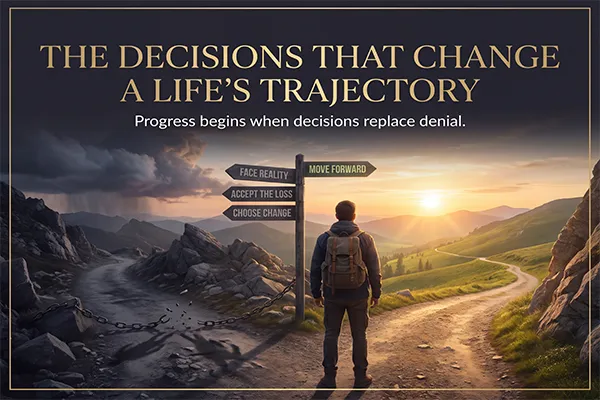
The Decisions That Change a Life’s Trajectory
Part 1
People do not remain trapped simply because they lack strength, intelligence, ambition, or hope.
They remain trapped when a difficult reality becomes psychologically easier to manage than the consequences of changing it.
The circumstances may not be their fault. Illness, loss, betrayal, economic collapse, violence, displacement, and institutional failure can alter a life without permission. But eventually, the question changes.
It is no longer only:
What happened to me?
It becomes:
What decisions are now required of me?
Progress rarely begins with motivation. It begins with a series of difficult internal decisions.
Progress starts with anger, sadness, frustration, or regret. Through disappointment, loss, or loneliness. Maybe all of the above.
The emotion, when channeled properly, often fuels the initiation of what becomes progress.
1. Reality Must Be Named Before It Can Be Changed
The first decision is to stop negotiating with facts.
Stop replaying the scenes. Stop rehearsing the conversations you’ve already had.
Stop rewriting the ending and stop writing the narrative for the future.
Be here.
Be present today.
Human beings are capable of sustaining extraordinary levels of contradiction when the truth threatens security, identity, attachment, status, or hope.
They reinterpret what is happening.
They minimize it.
They postpone judgment.
They confuse endurance with loyalty and optimism with strategy.
This is not always ignorance.
Sometimes it is psychological self-protection.
Reality may require an action the person does not yet feel prepared to take.
It may require leaving, admitting failure, confronting financial instability, accepting illness, relinquishing an identity, or recognizing that another person is not going to change.
Denial preserves emotional continuity.
It also preserves the problem.
Acceptance is not approval.
It is not surrender.
It is not the abandonment of hope.
It is the refusal to build a future on information already proven false.
A person begins to regain power when they can state the situation without softening it, dramatizing it, or rewriting it:
This is what happened.
This is what remains.
This is what it is costing me.
This is what must now change.
Clarity is often painful because it removes the protection of ambiguity.
It is also the beginning of movement.
2. A Loss Must Be Integrated Without Becoming an Identity
Not every effort succeeds.
Not every conversation goes as planned.
Not every job is yours to excel in.
Some careers end.
Some relationships fail.
Some businesses collapse.
Some decisions produce consequences that cannot be reversed.
Some goals remain unrealized despite discipline, intelligence, sacrifice, and good intentions.
The critical distinction is between acknowledging a loss and organizing the rest of life around it.
A psychologically integrated loss becomes information.
An unintegrated loss becomes identity.
When failure is treated as identity, the conclusion becomes:
I failed, therefore I am incapable.
I was rejected, therefore I am unworthy.
I lost, therefore I cannot recover.
That interpretation is more destructive than the original event.
Conceding a loss requires intellectual honesty.
It means examining what happened without self-deception, excuse-making, or compulsive self-punishment.
It requires separating what was uncontrollable from what was preventable.
The objective is not to preserve pride.
It is to improve judgment.
The strongest response to failure is neither denial nor humiliation.
It is accurate review.
What was misread?
What was tolerated too long?
What assumptions were wrong?
What warning signs were ignored?
What capacity was missing?
What must be done differently?
A loss becomes permanent defeat only when it is allowed to end adaptation.
3. Familiarity Must Stop Masquerading as Safety
People often remain in damaging circumstances because the known feels safer than the uncertain.
A familiar life may be emotionally barren, professionally limiting, financially unsustainable, relationally harmful, or psychologically corrosive.
Yet it still offers predictability.
Predictability reduces immediate anxiety.
That does not mean it produces long-term well-being.
The nervous system often prefers a known threat to an unknown future because the known threat has already been mapped.
The person understands the rules, the consequences, the emotional climate, and the compromises required to survive it.
Change removes that map.
This is why people remain in roles they have outgrown, relationships that require self-abandonment, environments that suppress them, and routines that no longer support the life they claim to want.
They are not always choosing happiness over misery.
They are choosing certainty over possibility.
The decision to leave familiarity is rarely accompanied by complete confidence.
More often, it requires acting while doubt, grief, fear, and instability are still present.
Growth does not require the absence of discomfort.
It requires deciding that the discomfort of change is more tolerable than the cost of continued self-betrayal.
4. Independence Must Not Become Isolation
The cultural language of resilience often glorifies self-sufficiency.
Survivor sounds empowering.
Strength.
People are praised for carrying impossible loads quietly, solving crises alone, and needing nothing from anyone.
Help is often delayed until the situation has become structurally unmanageable.
This is not always strength.
Sometimes it is fear, shame, pride, mistrust, or a learned expectation that support will be denied, weaponized, or withdrawn.
Effective recovery requires accurate assessment of capacity.
Some situations cannot be resolved through willpower alone.
They require legal expertise, medical treatment, financial intervention, emotional support, institutional advocacy, strategic partnership, or practical assistance.
Asking for help does not transfer responsibility.
It expands capability.
The relevant question is not:
Should I be able to do this alone?
It is:
What resources are required to change the outcome?
“I need help.”
“I need you.”
“I can’t do this.”
That’s empowering and that is strength.
Competent people do not prove their strength by refusing support.
They improve their odds by identifying what the situation demands and obtaining it.
5. Responsibility Must Be Separated From Blame
Not everything that happens to a person is caused by them.
But almost every difficult situation eventually requires them to decide what they will do next.
That distinction matters.
Blame asks who caused the damage.
Responsibility asks who now has the authority to respond.
A person can be innocent in origin and still responsible for recovery.
They may not have caused the betrayal, loss, abuse, illness, dismissal, collapse, or disruption.
But if they continue to repeat the same patterns, ignore the same evidence, return to the same environments, or abandon their own judgment, the original injury begins generating secondary consequences.
Self-examination is not self-condemnation.
It is pattern interruption.
The purpose is not to assume responsibility for another person’s misconduct.
It is to identify where personal choices, omissions, boundaries, fears, or beliefs allowed harm to continue longer than it should have.
The questions are difficult but necessary:
What did I know before I admitted it?
What did I excuse?
What did I repeatedly override in myself?
Where did fear make the decision?
What behavior must stop, even if the circumstances were not my fault?
Without this level of honesty, people may leave one painful situation only to recreate its structure somewhere else.
The Difference Between Endurance and Direction
Endurance is the capacity to survive what is happening.
Direction is the capacity to alter what happens next.
The two are not the same.
A person can survive for years without changing trajectory.
They can remain productive, responsible, loyal, hopeful, and outwardly functional while living inside circumstances that are steadily reducing their options.
The turning point is rarely dramatic.
It is usually a decision made without certainty:
To name the truth.
To accept the loss.
To tolerate the unfamiliar.
To request support.
To confront one’s own patterns.
These decisions do not guarantee immediate relief.
They do something more important.
They restore agency.
And once agency returns, the future is no longer controlled entirely by what happened.
It begins to be shaped by what happens next.
