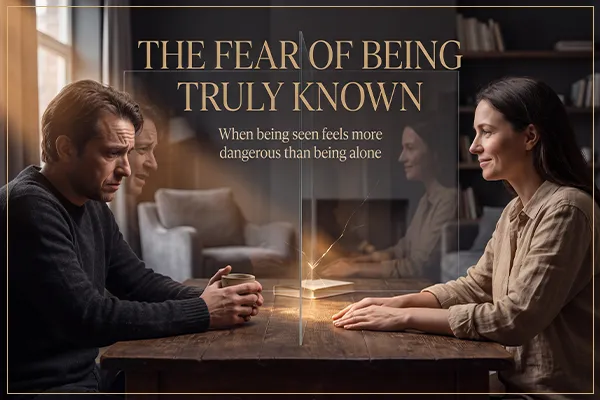
The Fear of Being Truly Known
Some people do not fear love itself.
They fear what love will discover if it gets too close.
They may want affection.
They may want companionship.
They may want warmth, loyalty, desire, comfort, and connection.
They may want someone to choose them, miss them, understand them, and make life feel less heavy.
But being loved is not the same as being known.
And some people spend their lives trying to receive one without risking the other.
Being loved from a distance can feel safe.
The person can control what is seen.
They can offer the good parts.
They can give access in pieces.
They can reveal enough to create closeness, then retreat before closeness becomes exposure.
This can look confusing to the person on the other side.
One moment, there is softness.
The next, distance.
One moment, truth appears.
The next, silence.
One moment, the person seems emotionally present.
The next, they are unreachable.
It can feel like mixed signals, but often it is an internal war.
The desire to be close is real.
The fear of being fully seen is also real.
And when those two forces collide, the person may pull someone near and push them away in the same emotional motion.
The fear is not always conscious.
Sometimes it lives in the body before it reaches the mind.
A hard question creates tension.
A vulnerable moment creates panic.
A need from someone else feels like accusation.
An honest conversation feels like danger.
A request for clarity feels like pressure.
The nervous system reacts before the heart can explain.
So the person shuts down.
They change the subject.
They become vague.
They delay.
They disappear emotionally.
They create distance and call it peace.
But peace built on avoidance is not peace.
It is fear with a quieter voice.
At the center of the fear of being known is often one brutal question:
If someone sees the real me, will they still love me?
Not the capable self.
Not the polished self.
Not the helpful self.
Not the successful self.
Not the version who knows how to perform stability.
The real self.
The one with shame.
The one with regret.
The one with fear.
The one with needs.
The one with contradictions.
The one who does not always know how to speak clearly.
The one who has hurt people by trying not to be exposed.
Being truly known means letting another person see more than the curated version.
That kind of intimacy can feel dangerous to someone who learned that love is conditional, disappointment is costly, conflict is unsafe, or failure is unbearable.
So they protect themselves.
They become selective with truth.
They reveal in flashes.
They admit just enough to relieve pressure.
They give pieces of honesty without giving full access to reality.
But partial truth creates partial safety.
A person on the other side may feel the closeness, but they also feel the wall.
They can sense the person is present and hidden at the same time.
That is a painful place to love from.
Because the person who wants to know them is not always trying to expose them.
Sometimes they are trying to understand them.
Sometimes they are trying to love them correctly.
Sometimes they are trying to create enough safety for both people to stop performing.
But fear does not always interpret love accurately.
Fear hears questions as threats.
Fear hears needs as demands.
Fear hears vulnerability as risk.
Fear hears accountability as rejection.
Fear hears closeness as the beginning of loss.
So the person avoids what could actually heal them.
They avoid the conversation that might bring relief.
They avoid the honesty that might create trust.
They avoid the vulnerability that might prove love can survive truth.
This is the tragedy.
The thing they fear may be the very thing they need.
To be seen and not abandoned.
To be known and not rejected.
To be imperfect and still loved.
To be honest and still safe.
But none of that can happen while the real self remains hidden.
Love cannot reassure a part of someone it is never allowed to meet.
That is why performance-based love eventually becomes exhausting.
It requires maintenance.
It requires concealment.
It requires the person to keep managing the distance between who they are and who they allow others to see.
And eventually, the people who love them feel the cost.
Because secrecy is not neutral.
Avoidance is not neutral.
Emotional distance is not neutral.
When a person refuses to be known, the other person is left loving around an absence.
They are close, but not fully in.
They are connected, but not fully trusted.
They are chosen in private, but not fully included in the truth.
That kind of love begins to hurt.
Not because there is no feeling.
Because the feeling has nowhere honest to land.
The fear of being known may begin as protection, but it eventually becomes the thing that keeps love from becoming safe.
At some point, a person has to decide whether they want to be loved for the image or loved inside the truth.
The image may be easier to control.
But the truth is the only place intimacy can survive.
