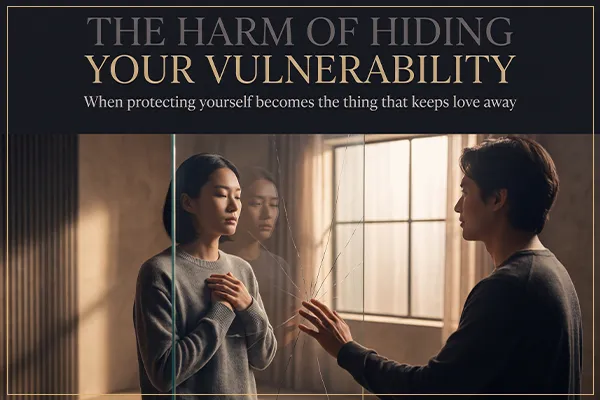
The Harm of Hiding Your Vulnerability
People often hide their vulnerability because they think it will protect them.
They hide the need.
The fear.
The longing.
The disappointment.
The wound.
The place inside them that wants to be held, chosen, reassured, understood, or loved without having to perform strength.
They tell themselves they are being mature.
They are being independent.
They are not asking for too much.
They are protecting the relationship.
They are avoiding pressure.
They are keeping the peace.
But hidden vulnerability does not disappear.
It becomes distance.
It becomes resentment.
It becomes loneliness.
It becomes unmet needs that slowly harden into emotional withdrawal.
It becomes the ache of feeling unseen by people who were never given the full truth of what needed to be seen.
This is one of the most painful contradictions in intimacy:
People want to be loved deeply while hiding the very parts of themselves that require love.
They present the capable version.
The easy version.
The low-maintenance version.
The strong version.
The version that does not need much, does not ask for reassurance, does not admit fear, does not say, “This hurts me,” does not confess, “I need you closer.”
Then they feel alone when the other person responds only to the version they were allowed to meet.
People cannot love what they are never allowed to see.
They can only respond to the version that keeps showing up.
That is the harm of hiding vulnerability.
It protects you from rejection, but it also protects you from being truly known.
And being unknown inside a relationship can become its own kind of grief.
There is a psychological cost to constant emotional concealment.
When someone repeatedly hides what they feel, the nervous system does not interpret that as peace.
It interprets it as suppression.
The body still carries the truth.
The need still exists.
The fear still pulses underneath the surface.
Eventually, the hidden thing starts leaking.
It leaks through irritability.
Distance.
Overthinking.
Testing.
Withdrawal.
Passive resentment.
Sudden emotional reactions that seem larger than the moment because they are carrying months or years of unspoken truth.
This is why vulnerability matters.
Not because every person deserves access to your deepest wounds.
They do not.
Vulnerability without discernment can become self-exposure without safety.
But in relationships that matter, hidden vulnerability creates invisible walls.
The other person may think they are close to you, but they are only close to the version of you that knows how to survive without asking.
And that version is often lonely.
Many people avoid vulnerability because they fear the response.
What if they do not care?
What if they leave?
What if they minimize it?
What if they use it against me?
What if I finally show the truth and it changes nothing?
Those are real risks.
But there is another risk people rarely name:
What if you hide your vulnerability so well that no one ever gets the chance to love you accurately?
What if the relationship fails not because the need was too much, but because the need was never spoken clearly enough to be met?
What if silence becomes the reason you remain emotionally starving beside someone who might have shown up differently if they had known where you were hurting?
This does not mean vulnerability guarantees love.
It does not.
Vulnerability reveals capacity.
That is its power.
When you show someone the truth, you learn what they can hold.
You learn whether they move closer or become defensive.
You learn whether your pain matters to them.
You learn whether intimacy deepens or whether the relationship was only safe when you were easy.
That information matters.
It may hurt, but it is honest.
Letting go sometimes begins when you stop hiding the truth from yourself first.
You admit:
“I need more.”
“This hurt me.”
“I am not okay with this.”
“I want to be known.”
“I want love that has room for my strength and my softness.”
There is no authentic intimacy without vulnerability.
There is no deep love without some risk of being seen.
The goal is not to expose your wounds to everyone.
The goal is to stop building relationships where your only acceptable role is strength.
Because strength without vulnerability becomes isolation.
And isolation, after a while, starts to look too much like survival.
