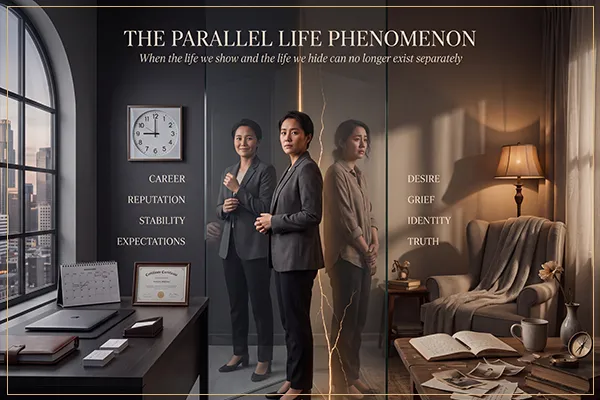
The Parallel Life Phenomenon
Some people live one life publicly and carry another life privately.
One life is visible.
It has structure.
It has obligations.
It has roles.
It has routines.
It has people who know where to place them.
The other life is hidden.
It may be emotional.
It may be relational.
It may be spiritual.
It may be a longing.
It may be a grief.
It may be a version of the self that never found permission to exist openly.
That is the parallel life phenomenon.
It is the life within the life.
The one no one sees completely.
The official life may look settled.
It may be respected, productive, responsible, and recognizable.
It may have all the marks of adulthood and achievement.
But somewhere outside that visible structure is another truth.
A desire.
A person.
A dream.
A grief.
A need.
A self.
A reality that does not fit neatly inside the life already built.
And because it does not fit, it gets placed somewhere separate.
A box.
Not gone.
Not fully chosen.
Not fully released.
Not fully integrated.
Just separate.
This is not always built from deception in the way people assume.
A parallel life is not always built from cruelty.
Sometimes it is built from fear, delay, and everything a person could not make room for in the life they already chose.
They may not know how to bring the hidden truth into the visible life.
They may fear who it would disappoint.
They may fear what it would disrupt.
They may fear what it would reveal.
They may fear the cost of admitting that something outside the official life feels more honest than the official life itself.
So they compartmentalize.
They place work here.
Family here.
Responsibility here.
Image here.
Longing over there.
Truth somewhere private.
Love somewhere carefully unnamed.
Compartmentalization can feel functional for a while.
It allows a person to keep moving.
It allows them to avoid immediate disruption.
It allows them to preserve the life everyone understands while still holding onto the truth they are not ready to choose.
But the human heart is not designed to live permanently split.
What remains separated starts to create pressure.
The hidden life asks for recognition.
The visible life asks for maintenance.
The person becomes the bridge between both.
That bridge gets heavy.
This is where people begin to feel the cost.
They are present, but not fully present.
They are committed, but not fully honest.
They are attached, but not fully free.
They are functioning, but internally divided.
A divided life creates a divided nervous system.
There is always something to manage.
What can be said.
What cannot be said.
Who knows what.
Who does not know.
Which truth belongs where.
Which part of the self is allowed in which room.
That kind of living is exhausting.
Not always dramatically.
Often quietly.
It shows up as distance.
Vagueness.
Avoidance.
Emotional fatigue.
Irritability.
Confusion.
The sense that peace is always close but never fully reachable.
Because peace requires integration.
A person cannot keep the truth locked outside the life and expect the life to feel whole.
This becomes especially painful in relationships.
The person kept in the hidden life may feel real, but not fully included.
They may feel loved, but separated.
Known, but contained.
Chosen in feeling, but not in structure.
Close, but boxed away from the rest of reality.
That creates a specific kind of pain.
It is not the pain of being nothing.
It is the pain of being something that has no visible place to stand.
And eventually, that person will feel the box.
They will feel the separation.
They will feel the limits.
They will feel the way the truth stops at the edge of another life.
No one can live indefinitely as someone’s private truth while the public life remains untouched.
At some point, the separation becomes the message.
The hidden life may have begun as protection, but it eventually becomes a form of abandonment — not only of another person, but of the self.
Because the person living the parallel life is also trapped.
They may think they are preserving peace, but they are preserving division.
They may think they are protecting others, but they are avoiding the honesty required to stop harming everyone slowly.
They may think they are delaying a decision, but delay is a decision when other people are forced to live inside it.
A parallel life cannot stay parallel forever.
Eventually, the lines collide.
The hidden truth begins to press against the visible life.
The emotional cost becomes too large.
The person can no longer pretend that what is separate is not shaping everything.
That moment is frightening.
But it can also be the beginning of integrity.
Because integrity is not perfection.
Integrity is when the outside life and the inside truth stop living as strangers.
It is when the person stops dividing themselves into acceptable and unacceptable parts.
It is when they stop asking love, desire, grief, truth, or identity to survive in a box.
A person does not become whole by hiding the life that makes them feel alive.
They become whole when they stop pretending the hidden life is not part of the real one.
